In this class I started to write about the story I ended up going with I wanted to explore and flesh out the areas that interested me but also to see what areas i could discover and explore. In this stage i didn’t want to limit myself to any particular area as Dave had mentioned previously it has to get messy before it can get tidy again. So basically this class was me just throwing everything put on the board and then at a later date i would try to narrow it and make more sense of it and to give it more flow.
Some of my early draft worked is highlighted below in red
Drill down on the aspect of the gaming culture and the desensitising of adults as well as children
My story is about how technology is changing human nature, its not just about gaming culture although that is an important and driving factor in this story. It is more about how technology started out as language moved to books and has now progressed to film and then how film progressed and how it has gotten shorter and snappier with the quick cuts of mtv to now the 90 second Instagram clips
frankenstein
The rise of the machines and the death of the spoken word. Games like red dead redemption are turning the youth into a Frankenstein and desensitising them to a kill or be killed culture.
It makes me think of a question that i was asked by someone why do i read? I never took the time to break it down into its component parts.
Spoken word why do you read brain training
So when you read you you decipher symbols, letters which are in sentences which describe ideas. Sentences then in turn develop concepts, they flesh them out and unpack complex ideas. Good writing describes concepts and great writing makes it accessible to a wider audience. It packages it in such a way that you reach people.
They confront people about uncomfortable parts of their personalities and the psychology behind them. This can allow for a catharsis and a healing and the development of a connection which is what can be so sorely missed in today’s society.
Social media smartphones
Social media also has contributed to this and the advent of the smartphone has brought us closer to to the technology than ever before. The concept of a keyboard warrior has allowed, even in the non anonymous form. Has allowed for people to be less compassionate and more easily offended. Saying things that you would never say in person and allowing people to take things up the wrong way in a text form where so much tone and intonation gets lost in the translation.
Machines as people
Another aspect of this piece would be to treat technology as a life form, this was done in the animatrix where they tracked and traced the technology i heard someone speak about it like our phones will be looked on as our slaves in the future by future sentient computers and they will look down upon the humans who had theses primitive forms of technology as slaves. How far could that be taken what constitutes a technology. Could words and books be considered a technology
The different types of technology could be considered different races in the machine world
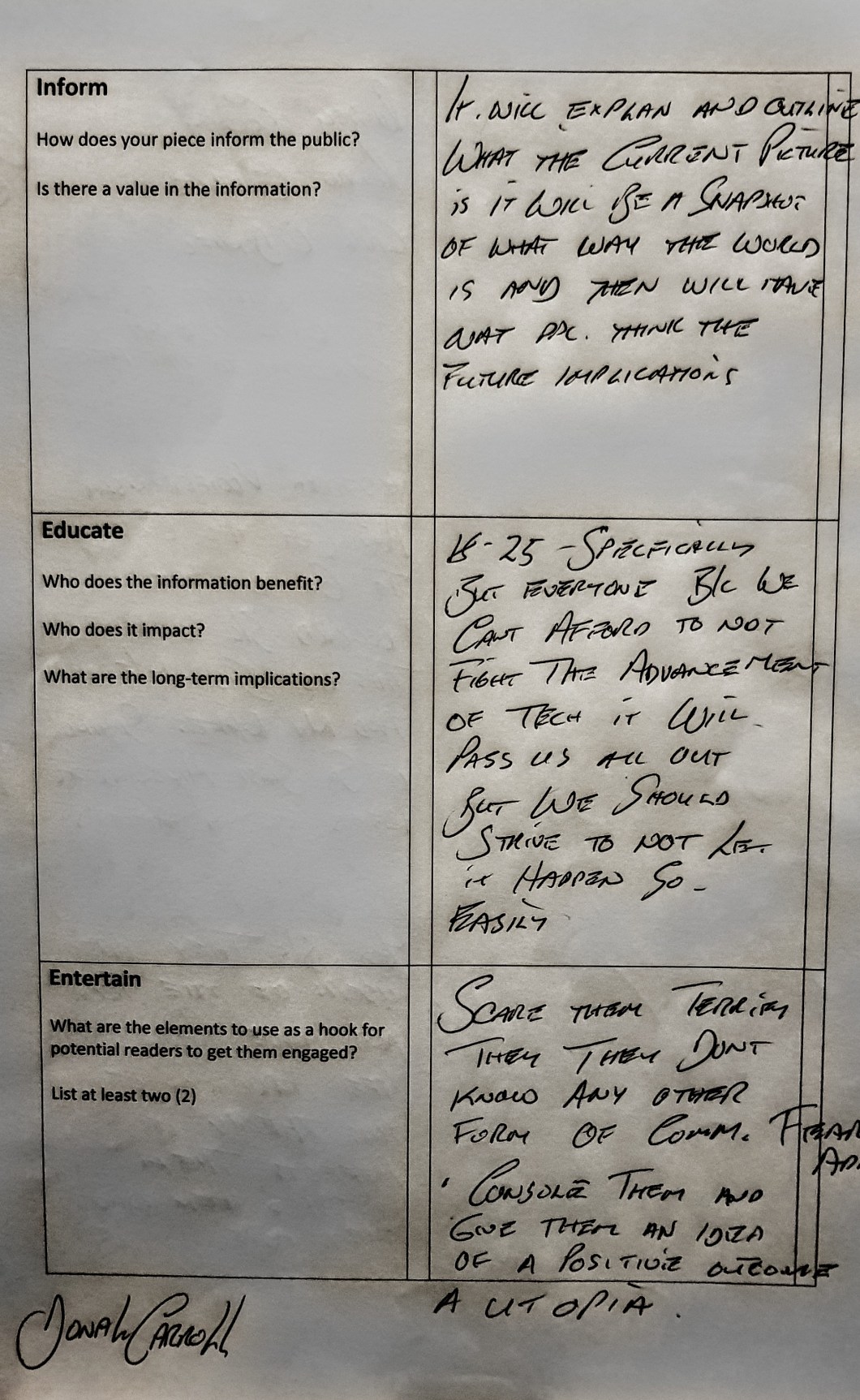
Below is a picture of some of my class notes as it relates to this blog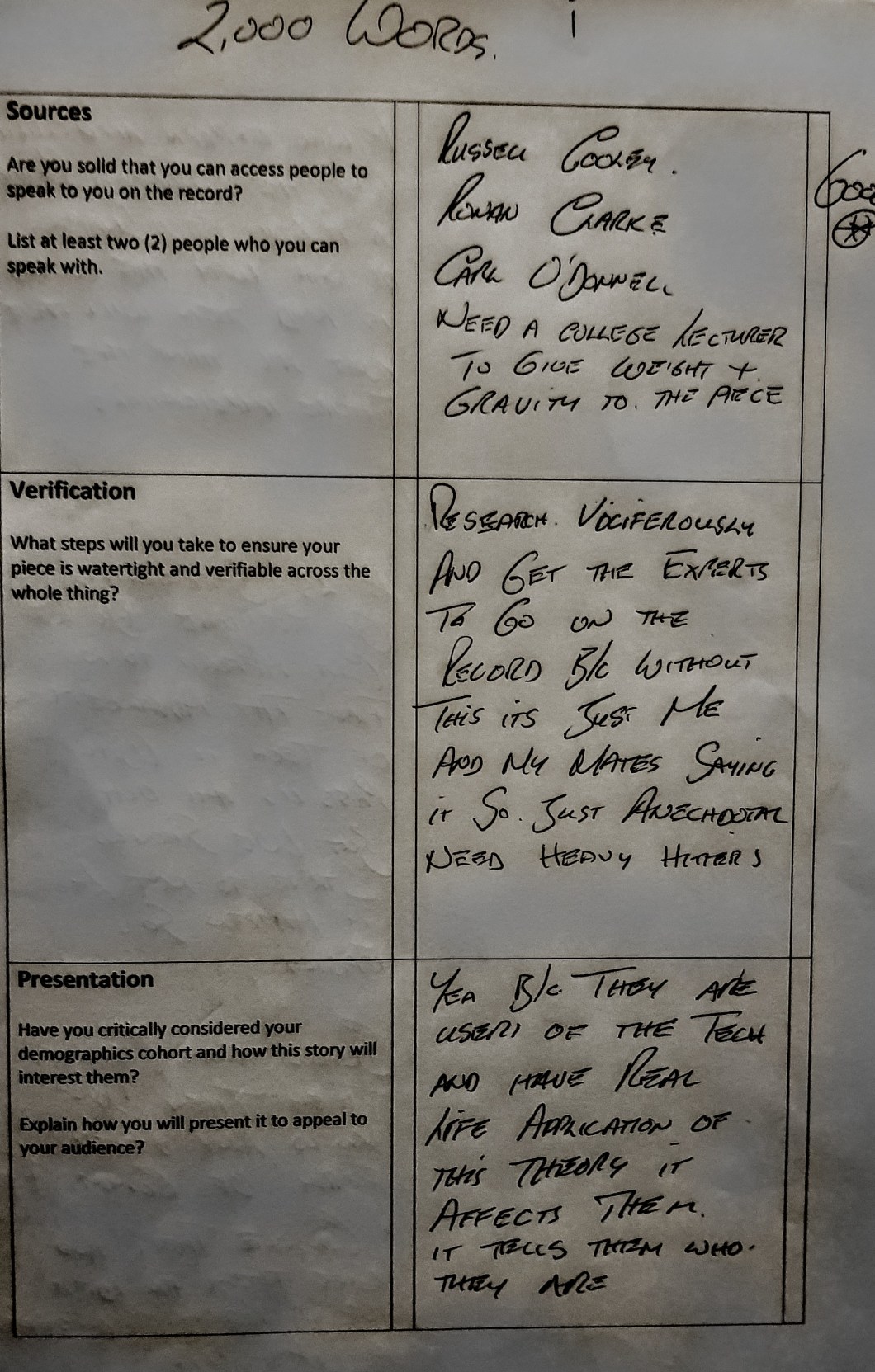
Below is some internet research I did for the piece
technological Systems/ 7 Types of Technology
- Construction Technology. Using systems and processes to put structures on the sites where they will be used.
- Communication & Information Technology. Developing and using devices and. …
- Medical Technology. …
- Transportation Technology. …
- Energy & Power Technology. …
- Agricultural Related Bio-Technologies. …
- Technology. …
https://www.theodysseyonline.com/the-death-of-nuance
Needless to say it is not my intention to follow suit. Instead I’d like to shift my focus onto what I find to be a more pressing and troubling development; that being the sacrifice of any sort of nuanced, objective truth for a more convenient and compelling narrative of half truths and blatant lies.
What we have seen from both sides is a rampant upswell in emotionality that has effectively undercut the prospects of logical and useful political discourse. Of course this has been brewing for some time, but it has only very recently boiled over to the point of unbearably toxic identity politics
Quite humorously, we’ve seen self ascribed torch bearers of their mutually disrespected ideologies call for unity without recognizing the inconvient fact that the onus is them to facilitate such a thing. Neither side seems to realize culpability they share for this demographic schism, and neither side seems to accept the responsibility needed to amend it. Instead, all we have been left with is the gloomy consolation of hyper-patriotic gloating from the right, and vitriolic bitterness and demagogery from the left.
If it is not clear that widespread political hostility can only perpetuate itself, it should be. And if you don’t think it could get any worse, it can. These problems won’t go away until we make some genuine attempt to fix them. It is only natural that we do not agree on every issue, but we cannot continue to be emotionally defensive of our own views to the extent that it effectively negates rational, productive conversation. All human progress relies on the unlikely prospect of effective conversation. This has always been the case. It is about as inconvenient a truth as you will find in nature, but hopefully it’s one we can all agree on. After all, it certainly wouldn’t be a bad place to start.
The impact that video has on our ability to read, watching video is a very passive activity when contrasted with reading because it gives you all the pictures automatically and doesn’t ask you to do any of the legwork to create the image. Books also have an ability to pause and drill down on specific parts like some of my favourite authors like that of charles dickens.
The drop in our attention spans and how scrolling has meant that we only have attention for a couple of minutes
Kate Edwards, president of the International Game Developers Association, gives the appropriate answer, “On the issue of violence, I think most game designers are cognizant of the role that violent actions serve in their game’s stories, similar to how a film’s scriptwriter or a book’s author leverages such acts to serve in stories they wish to tell.”
As Squire mentions, video games have clear, meaningful goals, multiple goal structures, scoring system, adjustable difficulty levels, random element of surprise, and an appealing fantasy metaphor, all things a good education system should have.
While yes, arguments can still be made for video games and their connection to violence, there can conversely be arguments made for video games and their beneficial, positive, effect on our world today, the world has been molded and shaped today by the characters we grow to love and adore, and hopefully, as video games continue to make leaps into a new future, so shall we.
https://www.theguardian.com/technology/2013/dec/02/how-video-games-changed-the-world-some-thoughts
The spread of the medium, from Pong in 1972 to Twitter (yes Twitter) today, has been one of quiet contagion.
what Brooker showed was that they have done so without anyone’s permission.
https://www.discovertec.com/blog/evolution-of-technology
Gartner, an analyst firm, speculates there will be more than 26 billion connected devices by 2020. Imagine a future where your car warns you of heavy traffic or your alarm clock notifies you about your coffee brewing itself in the kitchen. Imagine living in a smart home in a smart city.
https://nation.com.pk/23-Jul-2018/history-and-evolution-of-technology
The term came from the Greek word techne which means art and craft. It was first used to describe applied arts but now it is used to describe the advancement and changes around us.
https://www.huffingtonpost.com/dr-jim-taylor/the-evolution-of-technolo_b_318843.html?guccounter=1
Then, around 1835, Samuel Morse invented the telegraph, setting the stage for the greatest period of technological development in history that, in a relatively short time, has transformed our lives so dramatically. Think about it. The telegraph was a clear precursor to the Internet and the telegram was an early iteration of email.
Alexander Graham Bell’s patent of the telephone in 1876 (many have laid claim to having invented it) enabled humans to converse directly over great distances as if they werThe facsimile followed closely in the wake of the telephone, paving the way for the immediate transmission of something other than voice. For the first time, documents could be shared at a rate far faster than through the mail (what we now quaintly refer to as ‘snail mail’). e in the same room.
Mobile phone technology emerged for commercial use with the car phone around 1979 and progressively evolved to the present where mobile phones are now considered an indispensable part of our lives.
In 1994, the Internet was introduced to the public (it had actually been around since the 1960s), and it has likely been the single greatest leap forward in communication technology, enabling the instantaneous transmission of data, documents, still and moving images, and voice. It has created a veritable torrent of technology that has given us the Web, email, text messaging, and an array of applications, for example, MySpace, Facebook, Twitter, and Skype, that have dramatically altered the way we connect.
My concern is not in the technology itself; we cannot and should not try to slow or halt the inexorable march of progress. My interest is in our relationship with that technology and my concern is in how technology will affect us. Will we be passive recipients — dare I say victims? — of technology who allow it to change our lives for better or worse without consideration? Or can we be masters of our technology and deliberately harness its tremendous value while minimizing its risks?
The answer to these questions will depend not only on the technology itself that is developed, but also on our exploration of how new technology will influence our lives. Could anyone have predicted how the latest communication technology would change our lives? Maybe not, but I think it would be worth a try. Good questions to ask include:
- What are our goals for this technology?
- How will it influence how we interact with others?
- How will it affect how we use our time?
- What benefit will it bring to us?
- What costs might arise from its use?
- How can developers prepare us to best use this technology?
Potential technology expert interview
Professor David FitzPatrick, dean of engineering at UCD, is set to become the first president of Technological University Dublin.
Dr Joseph Ryan, who is the head of the Technological Higher Education Association (THEA), said he was delighted with the outcome.
https://www.thejournal.ie/tech-university-dublin-4131550-Jul2018/
President of Dun Laoghaire Institute of Art Design and Technology (IADT), Dr Annie Doona, takes over as Chairperson of the Board of the Technological Higher Education Association (THEA) on 1 January 2
With that purpose in mind, bringing technologists together with those who reside at the nexus of technology and humanity, for example, experts from psychology, philosophy, and sociology, would be invaluable in answering these questions. These are the types of people i am looking for.
Is technology making is dummer?
https://www.cso.ie/en/releasesandpublications/er/isshh/informationsocietystatistics-households2018/
Statistical backup for the rise of the machines in ireland
Marginally more females than males used the internet with the three months prior to interview – 83% compared with 82% of males. This follows the same trend as in previous years
 donalcarrollhack